

This is one of the longest-running film music e-zines providing hundreds of CD reviews over the years.
Also, there have been book reviews, film composer tributes, web surveys, and more over the past years.
Film Music Review (FMR) was first published online beginning in 1998.
From the beginning it featured reviews of both film scores and movie songs.
In 2020, it was moved to this new location. Some information is still available at the old FMR location — go here.
Check out the reviews and other items from the drop-down list at the top of this page,
including the titles in Film Music in Focus, listed in the order of their appearance over the years from 2007 onward.
Important Note:
Until proper funding is received, no new film music reviews will be posted on Film Music Review.
Volume I, Number 1 (8 July 1998):
These are the comments sent in after the first issue:
- “Clearly you have a long view of this art form – and that is good!” –Bob Bowd
- “I was very impressed when viewing your site…I appreciate your taste in film music” — Matthew Gear
- “Enjoyed your web site – nice job and very informative”– Randall D. Larson
- “I want to congratulate you on your new site – for me it’s one of the best review sites on the net (or in print) simply because it gets to the ‘meat’ of the story without all the fluff and nasty personal grudge stuff that seems to be standard at some other sites” — Mark Northam
- “Excellent site – straightforward, no nonsense and to the point. Every film music buff should visit it.” — David Wishart
Here are the abbreviated remarks about the soundtrack and compilation CDs
which received the highest rating (****) in the first issue in 1998.
Soundtracks:
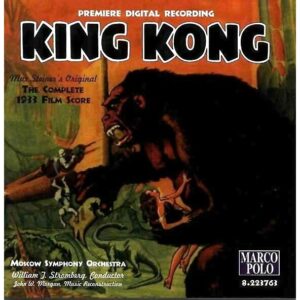
KING KONG – music by Max Steiner – Moscow Symphony Orchestra, William T. Stromberg, conductor (Marco Polo 8.223763) –
“Excellent first complete recording of Steiner’s landmark score. Essential for any film collector’s library.”
CLOSE ENCOUNTERS OF THE THIRD KIND – music by John Williams – Soundtrack (Arista 078-19004-2)
“The CD sound is superb…the previously unreleased music makes this CD a must have addition to any film music library.
TAXI DRIVER – music by Bernard Herrmann – Soundtrack (Arista 07822-19005-2)
“Includes all the music composed for the film, conducted by Bernard Herrmann, just before his death in 1975. The sound quality is top notch.”
THE HUNCHBACK OF NOTRE DAME – music by Alfred Newman – Moscow Symphony Orchestra, William T. Stromberg (Marco Polo 8.223750)
“38 minutes from Newman’s film score. Excellent notes by John Morgan and Bill Whitaker.”
Compilations:
WARNER BROS. – 75 YEARS OF FILM MUSIC – 4 CD Set (Rhino R2 75187) – Produced by George Feltenstein and Julie D’Angelo
“Great collection of Warner Bros. scores and songs from 1927 to 1997. Shouldn’t that title be: ’70 YEARS OF FILM MUSIC.’? In any case this is a massive collection lasting 5 hours, with 84 songs, main themes and suites. Even the old mono recordings sound wonderful…this set is worth having for the first CD alone. A landmark collection.”
20th CENTURY FOX – MUISC FROM THE GOLDEN AGE – Varese Sarabande VSD-5937 – Produced by Nick Redman
“A treasure chest of great 20th Century Fox score classics…the notes are informative and well written by Jon Burlingame.”
A Survey of Movie Songs:
Here is a list of 10 favorite songs from a web poll in 1999 on Film Music Review
sent in by readers.
The songs are listed in alphabetical order with the film listed where it is sung:
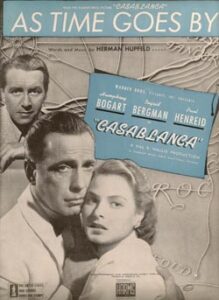
“As Time Goes By” (music & lyrics by Herman Hupfeld) from CASABLANCA, 1942
“Beauty And The Beast” (music: Alan Menken/lyrics; Howard Ashman) from BEAUTY AND THE BEAST, 1991
“Blue Skies” (music & lyrics by Irving Berlin) from WHITE CHRISTMAS, 1954
“But Not For Me” (music: George Gershwin/lyrics: Ira Gershwin) from GIRL CRAZY, 1943
“A Couple Of Swells” (music and lyrics by Irving Berlin) from EASTER PARADE, 1948
“It Might As Well Be Spring”(music by Richard Rodgers/lyrics: Oscar Hammerstein II) from STATE FAIR, 1945
“Laura” (music by David Raksin, lyrics by Johnny Mercer, 1945) from LAURA, 1944 (music only)
“Love Is Here To Stay” (music by George Gershwin/lyrics by Ira Gershwin) from AN AMERICAN IN PARIS, 1951
“Night And Day” (music and lyrics by Cole Porter) from THE GAY DIVORCEE, 1934
“On The Atcheson, Topeka And The Santa Fe” (music: Harry Warren/ lyrics: Johnny Mercer)
from THE HARVEY GIRLS, 1946
Editor’s Notes
I want to give special thanks to both Steven A. Kennedy and Steve Vertlieb for their years of work
as reviewers for Film Music Review.
Their participation has added a welcome range of reviews and tributes
as well as Best of the Year surveys.
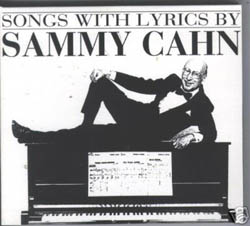
Oscar Meet Sammy!
One of the annual events announced on Film Music Review has been the Sammy Film Music Awards (or “Sammys”), which began in 1988, and were named after four-time Oscar-winning lyricist, Sammy Cahn (1913-1993), who also received an Emmy for “Love and Marriage” from a TV play of OUR TOWN.
The Sammy Awards were first announced on WGBH radio in Boston, Massachusetts.
These awards were the longest-running ones for film music recordings.
Unfortunately, these awards are now suspended due to lack of funding.
If you wish to help re-activate the Sammy Film Music Awards — go here
Note: A listing of all the Sammy Film Music Awards are available in the new ebook,
HOORAY FOR HOLLYWOOD — Memorable Movie Music (PineTree Press, 2026)
Readers Beware!
Unfortunately, some of the FMR articles have been copied without permission on the fan site, File 770.
No permission was given for the reprints on File 770.
They are in violation of the original copyright notice.
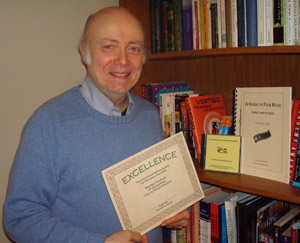
With best film music wishes,
Roger L. Hall, IFMCA Critic
Managing Editor, Film Music Review (FMR)
Director, The Sammy Film Music Awards (SFMA)
Moderator, Film Score Followers (FSF) — see Facebook
Roger Hall speaks with one of his writers, Steve Vertlieb,
about Film Music Review on YouTube — here

Now Showing!
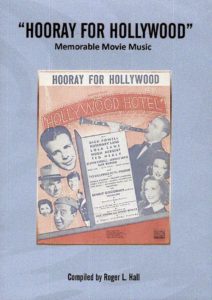
“Hooray For Hollywood” – Memorable Movie Music
What makes music memorable in a film?
This lavish new PDF book with numerous illustrations written by film music critic and historian, Roger L. Hall,
celebrates the century of music used in movies from the first use of synchorized sound
in DON JUAN in 1926 to film music today.
It includes interviews and reviews of film scores,
plus tributes to these twelve film composers with sample reviews:
Elmer Bernstein, Aaron Copland, Jerry Goldsmith, Bernard Herrmann,
Henry Mancini, Jerome Moross, Alfred Newman, David Raksin,
Miklos Rozsa, Max Steiner, Dimitri Tiomkin, and John Williams.
There are also interviews with these music producers:
James Fitzpatrick and Diana Friedberg,
and with these authors:
Steven C. Smith and Sally Stevens.
Plus there is a complete listing of the Sammy Film Music Awards from 1988 to 2020,
the longest-running awards for recordings of film music scores and songs.
To read how to order this book by film music critic and historian, Roger L. Hall
from PineTree Press, 2026, 450 pages — go here
Also available is an ideal book for movie fans, teachers and students
in a 9th updated edition
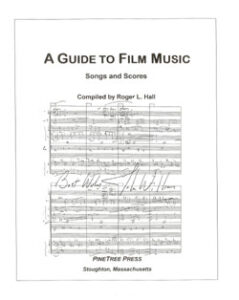
A GUIDE TO FILM MUSIC: Songs and Scores
Film Music Webinars
To ask about scheduling any of the following webinars listed below for your group via Zoom or other web format,
contact film music critic, Roger Hall, about scheduling any of the programs listed here.
Send your email — here
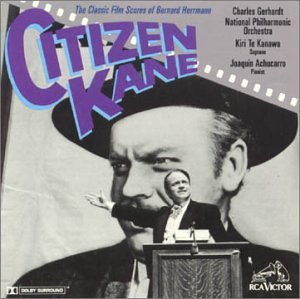
CITIZEN KANE: From Screenplay To Soundtrack
This special online webinar includes a discussion of the Oscar-winning screenplay
by Herman J. Mankiewicz and Orson Welles and the Oscar-nominated score by Bernard Herrmann.
This webinar is presented by film music critic, Roger Hall. It was previously presented to,
a Boston film group to help celebrate the 80th anniversary of the release of CITIZEN KANE (1941).
For his PowerPoint presentation he focuses on the Director, Co-Writer, and Actor, Orson Welles,
and the Oscar-nominated score by Bernard Herrmann,
This score is at the top of Roger’s list of 100 Essential Film Scores of the 20th Century.
See the interview with Roger by Jocelyn at her film lover’s blog — Classic Film Observations & Obsessions
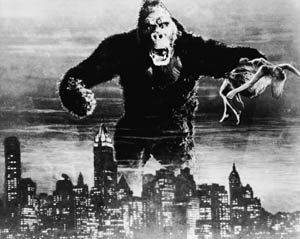
King Kong: Examining a Cinematic Legacy
KING KONG (1933) is considered to be the first major monster or fantasy film and remains the best.
How did it originate and who were the people most responsible for getting it made?
Sponsored by New York Adventure Club, this webinar presented by FMR Managing Editor, Roger L. Hall, explored the cinematic evolution of King Kong, from its groundbreaking debut in 1933 to the star-studded remakes of 1976 and 2005.
The illustrated survey focused on how KING KONG came into being, from its story to the screenplay, and the special visual effects, and especially the film scores by Max Steiner, John Barry, James Newton Howard.
This webinar was held in 2025 and again on March 2, 2026 –
the date when the KING KONG film was first released
in New York in 1933 and thousands viewed it!
To read the 75th anniversary tribute to the 1933 film and score by Max Steiner — go here
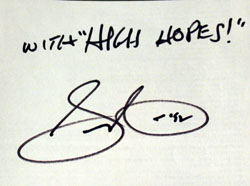
“High Hopes” – Great Hollywood Movie Songs
A discussion of movie songs from the 1930s to the 1960s,
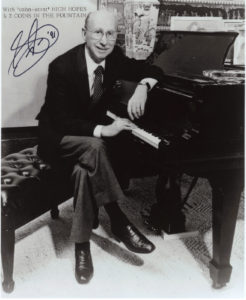
with a focus on several movie songwriters, including lyricist Sammy Cahn (signature shown above)
and composer Henry Mancini.
Video clips from will be shown as well as audio clips in this enjoyable music program.
See this centennial recording of lyrcis by Sammy Cahn 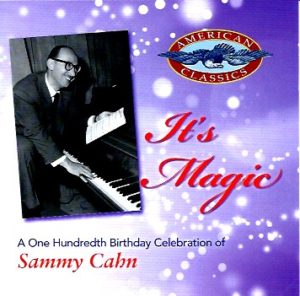
“It’s Magic” – A One Hundredth Birthday Celebration of Sammy Cahn

Film Noir in New York City: Hollywood’s Darkest Genre
Roger Hall has previously presented this webinar several times sponsored by the New York Adventure Club.
The topic was film noirs from the 1940s and 1950s which take place in New York City.
He will focus on these six films from the 1940s and 1950s and their music scores:
STRANGER ON THE THIRD FLOOR (RKO Radio, 1940)- music score: Roy Webb
THE NAKED CITY (Universal, 1948) – music score: Frank Skinner and Miklos Rozsa
SORRY, WRONG NUMBER (Paramount, 1948)- music score: Franz Waxman
THE WRONG MAN (Warner Bros., 1956) – music score: Bernard Herrmann
SWEET SMELL OF SUCCESS (United Artists, 1957) – music score: Elmer Bernstein
ODDS AGAINST TOMORROW (United Artists, 1959) – music score: John Lewis
Here are some of the comments from those who watched his earlier Film Noir webinar:
“Including the music, and the composer, as part of the experience–first time I’ve seen that. Bravo.”
“Interesting to learn what was shared about the defining elements of Noir (and the better translation of the term),
highlights in its history, and the like.”
“The presenter was very knowledgeable and enthusiastic about the subject matter.”
“Well organized and interesting. Very knowledgeable presenter.”
“Thank you for yet another fascinating and informative webinar!”
Roger Hall has written positive reviews for these two recommended Film Noir CD collections:
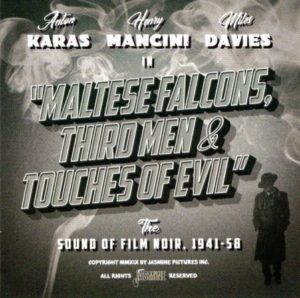
The Sound of Film Noir, 1941-58 (Jasmine, 2 CDs, 42 tracks)
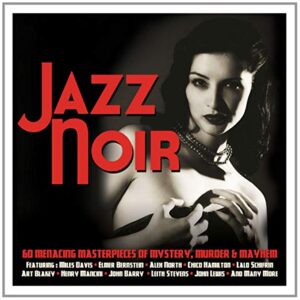
Jazz Noir (3 Disc Set with 60 tracks)

Best Film Score Releases of 2025
Roger Hall has invited me again this year to share a few thoughts about film music in 2025. There are so few physical releases these days as the CD format seems to be in its death throes even as the LP is on the return. As companies vie for control of content, there does appear to be a continued interest in physical product as what might have been available one month disappears to another streamer or is just removed altogether. Most everything sent for review now is downloaded and listened to in suboptimal computer audio.
Of course, against this is the increased immediate availability of score releases. We used to complain about the 30-minute CDs, now we can get downloads that exceed 2 hours of material. The happy medium is not met and most of these are for films and scores that are forgotten almost within the time they are released.
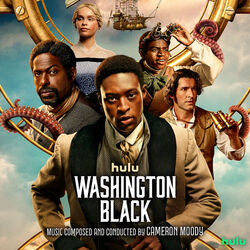
One of the best scores this year was for a Hulu mini-series, WASHINGTON BLACK, from a composer who has worked with Michael Abels, Cameron Moody. He finds a happy medium blending his use of Williams-esque style with his own and might be a breakout score for him.
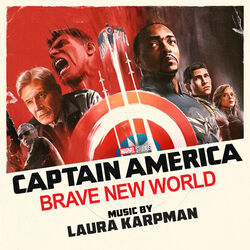
Laura Karpman’s score is also quite good and does what it can for CAPTAIN AMERICA: BRAVE NEW WORLD. John Lunn also capped his work for a beloved series with his DOWNTON ABBEY: THE GRAND FINALE score. Again nothing too new, but all competently handled. One might also say the same for Simon Franglen’s Horner-esque extension for AVATAR: FIRE AND ASH, a score that is over-represented in its streaming release.
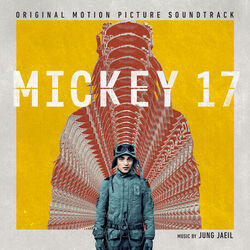
The best score though may be from the dystopian sci-fi film, MICKEY 17 by Jung Jae-Il. His approach is not in the big, sci-fi blockbuster style. Instead, it almost has the aestheitc of a Hisaishi reflection, but it humanizes the characters well and creates an interesting build towards the finale.
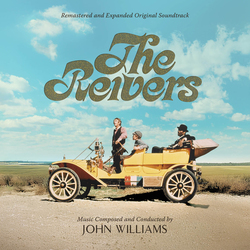
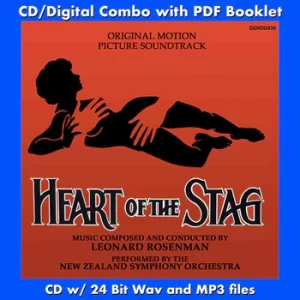
LaLa Land continued to build on its Bond catalog last year with some delays along the way (none submitted for review). Having a chance to revisit their extensive release for THE REIVERS was quite wonderful and about as complete a package for this score as one might hope. The other big release was their second volume of Paramount Western Scores, UNION PACIFIC—certainly worth adding to your collection along with the prior volume. Some great music and not all of it repeating western tropes. Dragon’s Domain Records continued an avalanche of releases many from their licensing of Southern Cross and Unikorn-Kanchana releases. These are mostly remasters and the one addition that has been absent for a while is the re-recording of Joseph Carter Breil’s BIRTH OF A NATION score. The musical connection between this and Steiner’s GONE WITH THE WIND can be heard and it is interesting to consider in light of the controversial aspects of both these films. The bigger surprise was their release of the wonderful score for a 1984 film, HEART OF THE STAG. This is another great Leonard Rosenman score.
Both Howard Shore (ANTHOLOGY-THE PARIS CONCERTS) and Alexandre Desplat (PARIS-HOLLYWOOD) released compilation albums. Shore’s is a mostly moody and odd collection of musical sequences from across his work. Desplat’s tends to be a bit more listenable as a concert experience on its own. This year’s Film Fest Ghent release focused on the work of Craig Armstrong (MUSIC FOR FILM) and it is fine for fans of the composer’s work, but tends to be quite repetitive with not as much stand out material as one might expect. As a survey of his work, it is still important though.
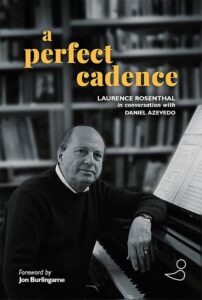
It was a good year for books about composers and films though. Perhaps the best is A PERFECT CADENCE which is a series of conversations with Laurence Rosenthal. Daniel Azevedo’s synthesis and organization of these memoir-like reflections is compelling reading. Stephen Eicke’s A DREAM COME TRUE was also an in-depth look at the work of Angelo Badalamenti and David Lynch which also provides great biographical context for their collaborations and their personal lives and experiences. Both of these works are worth adding to one’s reading list. The big John Williams autobiography by Tim Greiving was not sent to me for review and is on my reading list, but even with the sensationalized excerpts meant to entice readers, it will be an interesting source for fans of the composer’s work.
Each year becomes more difficult to find distinct and interesting scores that have staying power in the way of past decades. I do not think this is a sign of personal age. It is instead a signal that we are likely in another cultural and musical shift of creativity waiting for that new spark which will reignite film scoring again. There are plenty of scores from composers trying to do that whose voices must truly be sought out on the edges of minor labels and downloadable content. Sound familiar?
by Steven A. Kennedy, FMR and IFMCA Film Music Critic
January 2026
Book Reviews by Roger Hall
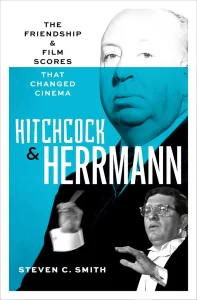
HITCHCOCK & HERRMANN: Friendship & Film Scores That Changed Cinema
By Steven C. Smith
Oxford University Press, 295 pages, 2025
To read the review — go here
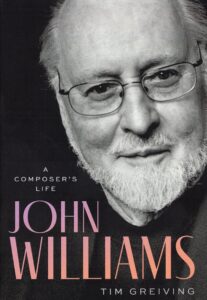
JOHN WILLIAMS: A Composer’s Life
By Tim Grieving
Oxford University Press, 630 pages, 2025
To read the review — go here
American Film Composers Series
See the 6 music collections available
featuring personal interviews and radio tributes about these five film composers
by Roger Hall:
No. 1: Virgil Thomson
No. 2: Aaron Copland
No. 3: Henry Mancini
No. 4: Bernard Herrmann
No. 5: John Williams
Read how to order these limited edition film music collections — go here
Best Film Score Releases of 2024
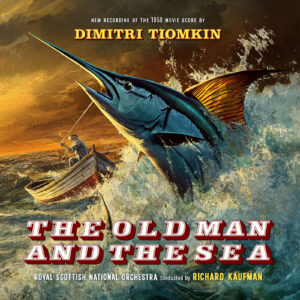
My choice for the best release of a film score from the past is this one, an Oscar-winner from 1958 by Dimitri Tiomkin,
released by Intrada. See Steven Kennedy’s comments below about this excellent release.
You can read my essay on Tiomkin’s “Golden Decade” from 1948 to 1958 at this link —
https://cnmsarchive.wordpress.com/2015/01/17/dimitri-tiomkins-golden-decade/comment-page-1/
I think generally the new film scores are becoming less and less distinctive. But I suppose there will still be an audience for them, especially among young listeners.
Unfortunately, fewer of the films today are receiving CD releases and instead available as downloads or on YouTube.
As someone who goes back to the long-playing or LP album days with film music and notes on the back cover,
I’m old-fashioned to still prefer having a CD to play and have comments to read about the release by a writer.
Once again, I thank longtime FMR critic, Steven Kennedy for his choices of the best releases for 2024.
You are invited to send in any comments at this email — here
— Roger Hall, FMR Editor
2024 in Review by Steven A. Kennedy
Somehow, we got through 2024 and as I reflect back on the year in film music it seems like we are at a new crossroads again. We have had the jazz era composers fade away, those who were part of the “return” to Golden Age Orchestral writing fade away, the rock-influenced composers become the “old guard” of sorts, and a new generation that blends all of these things and more now coming to the foreground. These tend to be more experimental and on the edges while mainstream scoring tends to continue a more repetitive approach to what has worked before. Honestly, many of the films released in 2024 just did not connect to me which may be a sign of age more than bad cinema, but it did feel like so many stories were rehashes of what has gone before, or over-bloated films that required 3 hours or more of one’s time. There were also a lot of re-issues of “expanded” scores which provide another opportunity for discovery.
Another thing that has almost made the film music reviewer irrelevant is the access of streaming music. Most everything sent for review is now a download. This means that a lot more music is available, but that much of it would never have seen the light of day in the LP or CD era. Sometimes that is a great thing because we can discover new voices and explore a bit more without breaking the bank. Though the plethora of streaming series scores is beyond overwhelming. Reviewing from one’s computer audio instead of an actual stereo system though is not great. It is not how I generally listen to anything. I know that I am probably in the minority here, but probably not generationally. I’m still honored when a composer specifically sends something for review because they want honest feedback and I do what I can. Most labels do not send physical product even for the restored and expanded older scores where sound quality is supposed to be one of the key advantages.
Are there some scores worth tracking down to add to your playlist? I think there are a few and I want to highlight some here as we wrap up the year.
Five scores from 2024 (alphabetical order)
THE FIRST OMEN is an excellent horror score from Max Korven (THE LIGHTHOUSE; CUBE; THE WITCH; OUR HOUSE) who is well-suited to tackle this genre. There is plenty of contemporary genre scoring, but it also has nods to Eastern European spiritual minimalist style. You can hear the latter in its choral approach and the former with its atmospheric textural jabs and stings. While the atonal undercurrent of the score enhances the more intense elements of the narrative, the moments of tonal clarity make these stand out more and even add to the terrifying nature of what they accompany. Each track devilishly entices you in for an often intense musical ride.
Michael Giacchino has somewhat blended into the rest of contemporary film scoring with his chameleon-like ability to inhabit many styles. That said, he still has a knack for finding a core hook for these family-weight films. IF’s score was released like a more traditional soundtrack with a blend of narrative direction. The outer suites provide a sort of overture and end title bookend that helps pull the score together here as a listening experience. Giacchino’s style is a blend of Desplat-like minimalism (reminiscent of the Wes Anderson scores) with his very own style used in his early Pixar scores. The primary theme is quite catchy and the orchestration throughout helps add to the impact of theme. Comedic segments have a requisite light feel but when the emotional buttons need to be hit, they certainly are. There is a heartbreaking quality to the way the theme pops up from time to time that causes a bit of pause and reflection. Here is where the score feels more like an extension of UP. Another of Giacchino’s wonderful lighter scores easily recommended to fans of his earlier Pixar contributions
KENSUKE’S KINGDOM is a great orchestral score by Stuart Hancock for an animated film that may be still hard to track down. It features strong thematic writing and engaging orchestration. The primary theme captures the imagination for this interesting musical journey. The central portion of the presentation slows down a bit for elements of darker mystery which creates a nice contrast. A sense of discovery also appears which adds an additional nice touch. If one appreciates big thematic and orchestral writing this may be a score for you.
The first season of Amazon’s THE RINGS OF POWER gave us one of the finest television series scoring events of the year. Season two builds on this with gorgeous orchestral writing, folkish material, and continued development of thematic ideas from season one. Certainly a must for fans of the series, and Bear McCreary’s work, who is again at the top of his game. The songs also are quite strong standouts here as well adding a beautiful poignancy and emotional impact. The thematic writing helps pull things together quite well. The echoes to the classic Howard Shore scores are certainly also present here linking these stories across the millennia in which they occur in this realm of many highlights for this season
Robin Carolan’s atmospheric score for 2022’s THE NORTHMAN was a good example of some of the newer trends in textural and design scoring. While NOSFERATU is not an easy listen, it creates the right atmosphere of creepiness and intensity that creates an extensive chilling listening experience. Effects are rather fascinating here both in terms of what Carolan does with the string orchestra (which occasionally moans and shrieks) against other atmospheric design elements. The little tremolo and small intervallic gestures are like musical bats fluttering about the texture. Here then is more a pick for the craft of scoring a film of this type with the latest technology.
BEST CLASSIC SCORE RELEASES
There is perhaps no better release to remind ourselves of the importance of Intrada to championing great film music than their late December release of THE OLD MAN AND THE SEA (1958). Richard Kaufman conducts this lovingly-restored re-recording of Dimitri Tiomkin’s score which is part seafaring adventure and part introspective drama. It presents the score complete for the first time. Tiomkin fans will enjoy the bigger orchestral music that has one foot in the past with its Golden Age sound, and one in the future with its unique harmonic writing. Jazzier moments and colorful Latin rhythms also make an appearance. This released as we also remember Douglas Fake (1952 – 2024) whose love for film music led to the creation of a label that continues to remind us of the great wealth of music in this genre. He will be missed.
I also want to briefly note a couple other older score releases which are from those categories mentioned in my introduction. One is an expanded release of Hans Zimmer’s score to BACKDRAFT (1991) from Intrada. The OST of this score focused more on Zimmer’s electronic hybrid work and was one of many early lightning rod scores for people not ready for his scoring style. This release allows listeners to hear the score in a more complete way as intended which is still quite impressive. The other is THE SUGARLAND EXPRESS (1974) released from La-La Land. This is a great example of John Williams in popular music mode with basic thematic lines that were then improvised and expanded by the ensemble hired to experiment with these threads. It is not an earth-shattering score, nor is it one of his best, but it did fill in some gaps in his discography. We should also note that La-La Land is also on a Bond kick with a host of scores being released from that iconic series. And, I also want to note that BuySoundtrax.com has been uploading a variety of the old Franz Waxman recordings made for Citadel bringing those back for a wider audience on most streaming platforms and for downloadable purchase.
BEST COMPILATION RELEASE
Film Fest Ghent honors a different composer each year and then releases a compilation from their celebratory concerts. This year’s focus was Elliot Goldenthal, a voice that exploded into film music in the 1990s with his unique orchestral writing in a more postmodernist style. The current release revisits 11 scores from 1992-2009 providing a great survey of some of his finest work. Performances are all great here and most will head to their collections to grab and revisit the scores here and others not able to be included. It is a reminder of one of the unique orchestral writers of the last quarter century.
So, there you go. A rather eclectic set of releases and scores to consider as is often the case. It is not by any means exhaustive but hopefully can provide some listening enjoyment for a few new scores in this transitioning time.
By Steven A. Kennedy—31 January 2025
Film Music Review is pleased to announce its association with this extensive site
and recommend it for your viewing:

Here are some of the articles by Roger Hall reprinted from Film Music Review:
–Aaron Copland talks about Film Music
—An Interview with James Fitzpatrick
—An Interview with David L. Fuller
—Max Steiner: Maestro of Movie Music
A sad announcement:
In addition to his great work on CINESCORES CENTER, Jeannot Boever was also the one who published numerous articles from Soundtrack Magazine on Soundtrack! The Cinemascore and Soundtrack Archive website.
He died on 4 February 2024.
R.I.P. dear friend.
Longest running awards for film music recordings
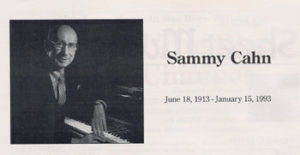
The Sammy Film Music Awards were begun in 1988
and have been the longest-running awards for film music recordings.
They were first announced on WGBH radio in Boston.
The awards were named in honor of film lyricist, Sammy Cahn,
who received 4 Academy Awards for his song lyrics.
He was nominated 26 times, more than any other past film songwriter.
Help the Sammy Film Music Awards continue by ordering
this commemorative CD (not available from Amazon)
funded by the American Music Recordings Archive (AMRA),
with all 4 of his Oscar-winning songs sung by an outstanding ensemble of singers and a jazz combo.
The CD contains over one hour of enjoyable music!
To your order the music on
this special limited edition CD — go here
The International Film Music Critics Association Awards
See all the award winners for 2025 —
IFMCA Award Winners 2025

See all the award winners for 2024 — click here

See the award winners for 2023 — click here

Award Winners for 2022 have been announced — go here
For the list of 2021 award winners — go here
For the complete list of 2020 award winners — go here